Click here for a PDF of the lenalidomide capsules copay card.(opens in a new tab)
Click here for full Prescribing Information including Boxed Warning.(opens in a new tab)
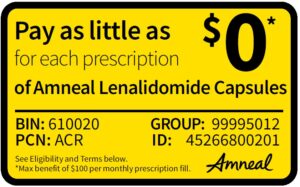
BIN: 610020
PCN: ACR
GROUP: 99995012
ID: 45266800201
*Max benefit of $100 per monthly prescription fill. See Eligibility and Terms below.
Exclusively for Amneal-labeled Lenalidomide Capsules
To Patient: Commercially insured patients can use this copay card to reduce out-of-pocket expenses on eligible prescriptions filled with Amneal Lenalidomide Capsules. Mention this offer to your pharmacy along with a valid lenalidomide prescription for an FDA-approved use. A monthly and yearly maximum savings benefit applies. By using this offer, you acknowledge that you meet the Eligibility Criteria and will comply with the Terms and Conditions set forth below.
To Pharmacist: Offer valid for SECONDARY claims only. Process a Coordination of Benefits (COB/split bill) claim using the patient’s prescription insurance for the PRIMARY claim. Submit the SECONDARY claim to PDMI under BIN: 610020. Patient will receive a maximum of $100 off per monthly prescription fill for their out-of-pocket cost.
For pharmacy processing questions, please call 330-757-8402.
Eligibility Criteria/Terms & Conditions:
*Max benefit applies.
Note: Because of the embryo-fetal risk, lenalidomide is available only through a restricted program under a Risk Evaluation and Mitigation Strategy (REMS), the Lenalidomide REMS program. Further information about the Lenalidomide REMS program is available at www.lenalidomiderems.com or by telephone at 1-888-423-5436.
Lenalidomide Capsule
Important Safety Information
WARNING: EMBRYO-FETAL TOXICITY, HEMATOLOGIC TOXICITY and VENOUS and ARTERIAL THROMBOEMBOLISM
Embryo-Fetal Toxicity
Do not use lenalidomide during pregnancy. Lenalidomide, a thalidomide analogue, caused limb abnormalities in a developmental monkey study. Thalidomide is a known human teratogen that causes severe life-threatening human birth defects. If lenalidomide is used during pregnancy, it may cause birth defects or embryo-fetal death. In females of reproductive potential, obtain 2 negative pregnancy tests before starting lenalidomide treatment. Females of reproductive potential must use 2 forms of contraception or continuously abstain from heterosexual sex during and for 4 weeks after lenalidomide treatment. To avoid embryo-fetal exposure to lenalidomide, lenalidomide is only available through a restricted distribution program, the Lenalidomide REMS program.
Information about the Lenalidomide REMS program is available at www.lenalidomiderems.com or by calling the REMS Call Center at 1-888-423-5436.
Hematologic Toxicity (Neutropenia and Thrombocytopenia)
Lenalidomide can cause significant neutropenia and thrombocytopenia. Eighty percent of patients with del 5q myelodysplastic syndromes had to have a dose delay/reduction during the major study. Thirty-four percent of patients had to have a second dose delay/reduction. Grade 3 or 4 hematologic toxicity was seen in 80% of patients enrolled in the study. Patients on therapy for del 5q myelodysplastic syndromes should have their complete blood counts monitored weekly for the first 8 weeks of therapy and at least monthly thereafter. Patients may require dose interruption and/or reduction. Patients may require use of blood product support and/or growth factors.
Venous and Arterial Thromboembolism
Lenalidomide has demonstrated a significantly increased risk of deep vein thrombosis (DVT) and pulmonary embolism (PE), as well as risk of myocardial infarction and stroke in patients with multiple myeloma who were treated with lenalidomide and dexamethasone therapy. Monitor for and advise patients about signs and symptoms of thromboembolism. Advise patients to seek immediate medical care if they develop symptoms such as shortness of breath, chest pain, or arm or leg swelling. Thromboprophylaxis is recommended and the choice of regimen should be based on an assessment of the patient’s underlying risks.
CONTRAINDICATIONS
Pregnancy: Lenalidomide can cause fetal harm when administered to a pregnant female. Lenalidomide is contraindicated in females who are pregnant. If this drug is used during pregnancy or if the patient becomes pregnant while taking this drug, the patient should be apprised of the potential risk to the fetus.
Severe Hypersensitivity Reactions: Lenalidomide is contraindicated in patients who have demonstrated severe hypersensitivity (e.g., angioedema, Stevens-Johnson syndrome, toxic epidermal necrolysis) to lenalidomide.
WARNINGS AND PRECAUTIONS
Embryo-Fetal Toxicity:
Lenalidomide REMS Program: Prescribers and pharmacies must be certified with the Lenalidomide REMS program by enrolling and complying with the REMS requirements. Patients must sign a Patient-Physician agreement form and comply with REMS requirements; female patients of reproductive potential who are not pregnant must comply with the pregnancy testing and contraception requirements and males must comply with contraception requirements. Pharmacies must be certified with the Lenalidomide REMS program, must only dispense to patients who are authorized to receive lenalidomide and comply with REMS requirements.
Hematologic Toxicity: Lenalidomide can cause significant neutropenia and thrombocytopenia. Monitor patients with neutropenia for signs of infection. Advise patients to observe for bleeding or bruising, especially with use of concomitant medication that may increase risk of bleeding. Monitor complete blood counts (CBC) in patients taking lenalidomide for MDS weekly for the first 8 weeks and at least monthly thereafter.
Venous and Arterial Thromboembolism: Venous thromboembolic events (VTE[DVT and PE]) and arterial thromboses (ATE, myocardial infarction and stroke) are increased in patients treated with lenalidomide. Patients with known risk factors, including prior thrombosis, may be at greater risk and actions should be taken to try to minimize all modifiable factors (e.g., hyperlipidemia, hypertension, smoking). Thromboprophylaxis is recommended. The regimen of thromboprophylaxis should be based on an assessment of the patient’s underlying risks. ESAs and estrogens may further increase the risk of thrombosis and their use should be based on a benefit-risk decision in patients receiving lenalidomide.
Increased Mortality in Patients With CLL: In a clinical trial in the first line treatment of patients with chronic lymphocytic leukemia, single-agent lenalidomide therapy increased the risk of death as compared to single-agent chlorambucil. Serious adverse cardiovascular reactions, including atrial fibrillation, myocardial infarction, and cardiac failure occurred more frequently in the lenalidomide treatment arm. Lenalidomide is not indicated and not recommended for use in CLL outside of controlled clinical trials.
Second Primary Malignancies: In clinical trials in patients with MM receiving lenalidomide, an increase of hematologic plus solid tumor primary malignancies (SPM) notably AML and MDS have been observed. Monitor patients for the development of second primary malignancies. Take into account both the potential benefit of lenalidomide and risk of second primary malignancies when considering treatment.
Increased Mortality in Patients With MM When Pembrolizumab Is Added to a Thalidomide Analogue and Dexamethasone: In clinical trials in patients with MM, the addition of pembrolizumab to a thalidomide analogue plus dexamethasone, a use for which no PD-1 or PD-L1 blocking antibody is indicated, resulted in increased mortality. Treatment of patients with MM with a PD-1 or PD-L1 blocking antibody in combination with a thalidomide analogue plus dexamethasone is not recommended outside of controlled clinical trials.
Hepatotoxicity: Hepatic failure, including fatal cases, has occurred in patients treated with lenalidomide in combination with dexamethasone. Pre-existing viral liver disease, elevated baseline liver enzymes, and concomitant medications may be risk factors. Monitor liver enzymes periodically. Stop lenalidomide upon elevation of liver enzymes. After return to baseline values, treatment at a lower dose may be considered.
Severe Cutaneous Reactions: Severe cutaneous reactions including Stevens-Johnson syndrome (SJS), toxic epidermal necrolysis (TEN), and drug reaction with eosinophilia and systemic symptoms (DRESS) have been reported. These events can be fatal. Patients with a prior history of Grade 4 rash associated with thalidomide treatment should not receive lenalidomide. Consider lenalidomide interruption or discontinuation for Grade 2 to 3 skin rash. Permanently discontinue lenalidomide for Grade 4 rash, exfoliative or bullous rash, or for other severe cutaneous reactions such as SJS, TEN, or DRESS.
Tumor Lysis Syndrome (TLS): Fatal instances of tumor lysis syndrome (TLS) have been reported during treatment with lenalidomide. The patients at risk of TLS are those with high tumor burden prior to treatment. Monitor patients at risk closely and take appropriate preventive approaches.
Tumor Flare Reaction: Tumor flare reaction (TFR), including fatal reactions, have occurred during investigational use of lenalidomide for CLL and lymphoma. Tumor flare may mimic progression of disease (PD). In patients with Grade 3 or 4 TFR, it is recommended to withhold treatment with lenalidomide until TFR resolves to ≤Grade 1.
Impaired Stem Cell Mobilization: A decrease in the number of CD34+ cells collected after treatment (>4 cycles) with lenalidomide has been reported. In patients who are auto-HSCT candidates, referral to a transplant center should occur early in treatment to optimize the timing of the stem cell collection.
Thyroid Disorders: Both hypothyroidism and hyperthyroidism have been reported. Measure thyroid function before start of lenalidomide treatment and during therapy.
Hypersensitivity: Hypersensitivity, including angioedema, anaphylaxis, and anaphylactic reactions to lenalidomide has been reported. Permanently discontinue lenalidomide for angioedema and anaphylaxis.
ADVERSE REACTIONS
Multiple Myeloma
DRUG INTERACTIONS
Periodically monitor digoxin plasma levels, in accordance with clinical judgment and based on standard clinical practice in patients receiving this medication, during administration of lenalidomide. Erythropoietic agents, or other agents that may increase the risk of thrombosis, such as estrogen containing therapies, should only be used with caution after making a benefit-risk assessment in patients receiving lenalidomide. It is not known whether there is an interaction between dexamethasone and warfarin. Close monitoring of PT and INR is recommended in patients with MM taking concomitant warfarin.
USE IN SPECIFIC POPULATIONS
You are encouraged to report negative side effects of prescription drugs to the FDA. Visit www.fda.gov/medwatch, or call 1‑800‑FDA‑1088.
Please see full Prescribing Information including Boxed Warning.(opens in a new tab)
©2026 Amneal Pharmaceuticals LLC. All rights reserved. PP-MMT-US-0005

 Corporate
 India
India